


Why choose Moneypenny?

Awesome receptionists you'd be happy to hire yourself

Intelligent call handling software so we are seamless and efficient

A perfected, one-of-a-kind call answering enviornment
The Customer Caller
Experience Divide
Same conversation.
Different story.

About the research
To understand the gap between what businesses believe they’re delivering and what customers actually experience, Moneypenny commissioned research among two complementary audiences across the US in March 2026.
- Business decision-makers: 2,000 senior decision-makers
- US consumers: 2,000 adults, nationally representative
Both surveys were conducted online. Where themes overlap, questions were aligned to enable direct comparison - with gaps reported as percentage-point differences to quantify the customer experience divide.
Results are shown as percentages. Figures may not total 100% due to rounding; totals may exceed 100% for multi-select questions.
|
|
Research conducted by Censuswide, an international market research consultancy, in line with ESOMAR principles and industry standards including those set by the Insights Association. |

One thing we hear consistently from clients is how difficult it’s become to balance rising customer expectations with the practicalities of running a business. Costs are under pressure, teams are leaner, and the number of ways customers can get in touch keeps growing.
The bar for "good" isn't set by your industry. It’s set by every effortless experience people have had elsewhere; the playlist that anticipates your mood, the returns process that took less than thirty seconds.


Jesper With-Fogstrup
Chief Executive Officer
Moneypenny
Across every contact method we tested, businesses were significantly more likely than customers to say it “meets expectations well”.
When leaders think they’re already doing well, they stop asking the harder questions. And if you’re not actively looking for friction, you won’t see it. That’s how small dissatisfactions quietly pile up, until there’s a real gap between what customers experience and what the business assumes it’s delivering.
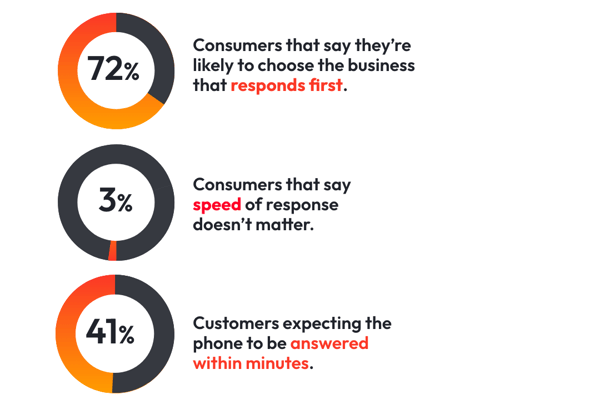
Your customers operate in a world where they order dinner, book taxis, and stream films on demand. They’re not going to wait around for your callback.

And customers aren't giving you much time to get it right:

Miss these windows and you've lost many customers before you've even had a chance to respond.
Why responsiveness builds loyalty
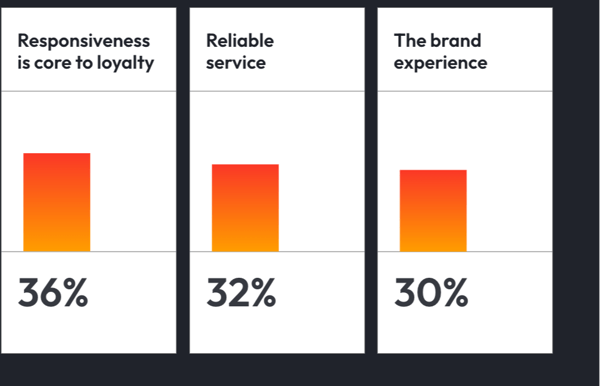
Speed gets you the chance to compete, but it doesn't win trust on its own. Responsiveness is what customers notice first, and it's one of the quickest ways to turn a good interaction into repeat business.
We asked consumers what drives loyalty

Most businesses get this and aim high, especially on the phone. The problem isn't effort, it's bandwidth. When teams are stretched, you don't always get a complaint, you just never hear from that customer again.
Many businesses say they'll respond within 24 hours. Fewer can prove they consistently hit that promise. When response expectations aren't tracked at individual or team level, they stop being a standard and start being an aspiration. Without clear ownership, clear targets, and visibility of missed moments, “we'll respond within 24 hours” quietly becomes a tick-box exercise. Shared responsibility has a habit of becoming nobody's responsibility.
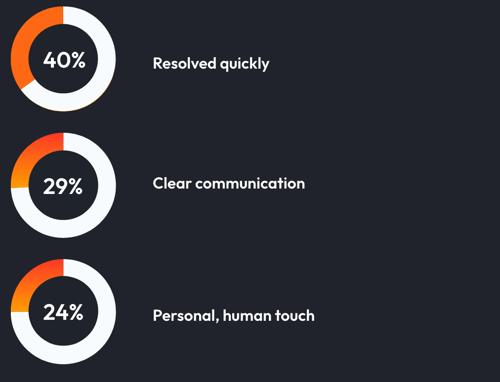
What customers remember isn't what businesses think

.png?width=800&height=800&name=NailBasics-1-10%20(1).png)
It’s practical stuff that lands: sort it quickly, communicate clearly, and don’t make people feel like a number.
And 1 in 10 consumers can’t think of a single memorable service experience at all, not because customers are cold, but because so much service simply doesn’t leave a mark. If you can be the business that shows up quickly, explains what happens next, and takes ownership, you’ll be remembered for all the right reasons.
Not everybody chooses to sit down to make a personal phone call at 2pm on a Wednesday, particularly if it’s in the middle of their working day. Real life leaves gaps at the edges: early mornings, evenings, weekends. The businesses that show up in those moments don't just win the enquiry, they win trust.

-1.png?width=500&height=411&name=Afterhours-supportwhen%20(1)-1.png)
Weekday 9 to 5 is still the single biggest 'best fit', but the real story is that timing matters, and a lot of customer demand actually sits outside the traditional working day.
That’s why the human safety net isn’t a nice-to-have, it’s intrinsic to the proposition.
The real opportunity is pairing AI with your colleagues’ judgement, empathy, and brand understanding so every interaction stays intuitive, flexible, and genuinely human when it matters most.
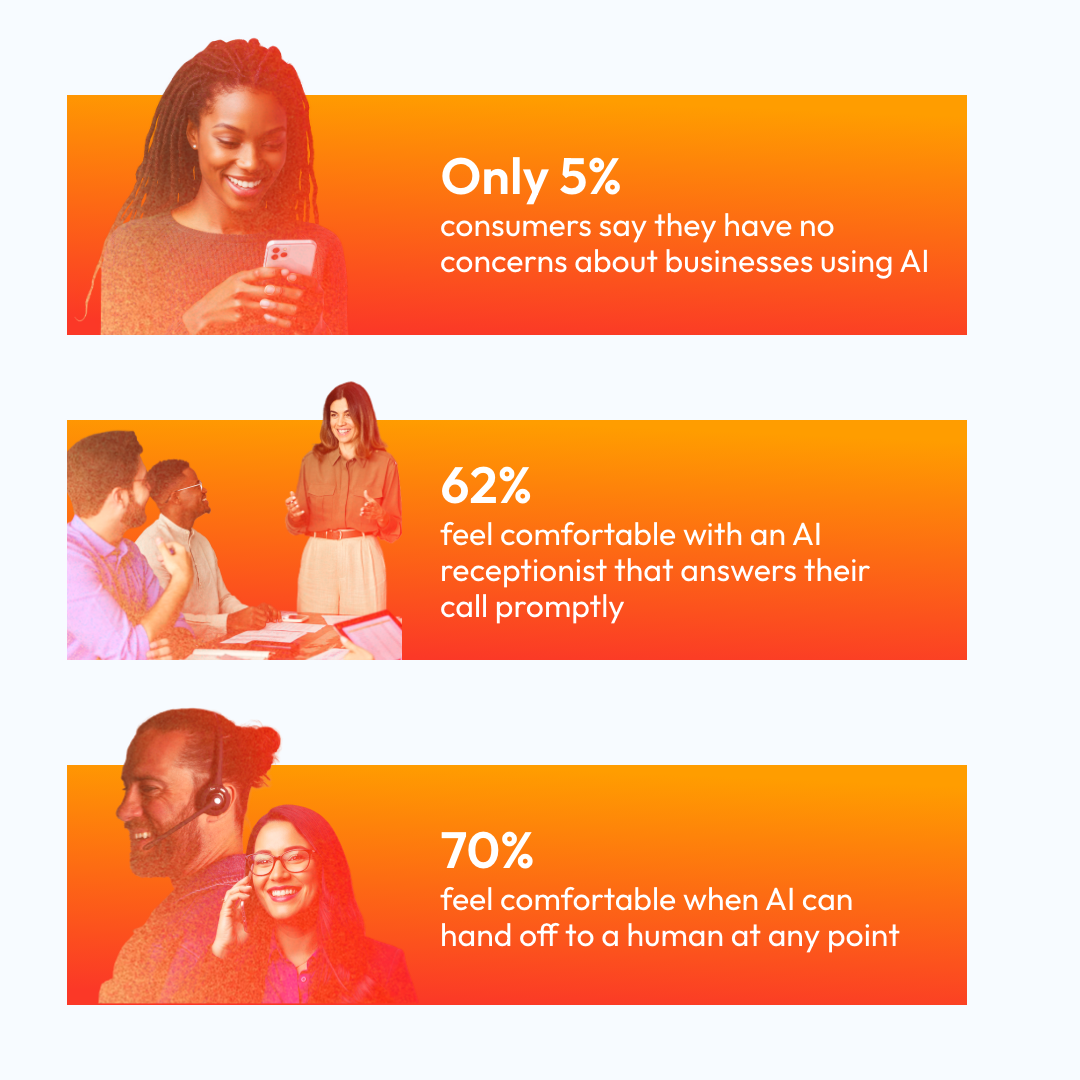
✔ Only 5% of consumers say they have no concerns about businesses using AI in customer service
✔ 62% feel comfortable with an AI receptionist that answers their call promptly
✔ 70% feel comfortable when AI can hand off to a human at any poin
If you need support handling your calls, talk to us today at 866-766-5050.


Practical next steps:
One of the clearest signals in the research is that customers don’t necessarily want AI to replace the conversation, they want it to accelerate it.
When AI answers quickly, routes enquiries efficiently, or handles simple tasks, it improves the experience.
That’s why the most effective AI experiences are the ones that make things feel faster and simpler, while still keeping the human option close at hand.


Pete Hanlon
Chief Technology Officer
Moneypenny
Telephone Answering
Your dedicated Moneypenny Receptionist answers and fulfils caller needs whenever you can't, with the professionalism and warmth of someone who genuinely knows your business.